In the Vietnamese kitchen there is a lunchbox made of stacked tiers fastened with a clasp. It is called "cà mên." An article published by Saigoneer on September 25, 2026 traces the name back to the French word gamelle, recalls how during the rationing era everyone's cà mên held the same meager contents, and shows how the vessel still carries porridge and pho along hospital corridors today—drawing on colonial-era newspaper advertisements and press coverage going back to 1988. As a souvenir it can be found for as little as the 60,000-dong range, a piece of everyday twentieth-century life you can hold in your hand.
The large pot that seven or eight French soldiers shared left only its name behind in Vietnam
Gamelle traces back through the Spanish gamella to the Latin camella
The word comes from the French gamelle. Consulting French and English dictionaries, the word entered French in 1584 from the Spanish gamella (a feeding trough or container), which in turn goes back to the Latin camella (spelled gamella in the French source, a vessel for drinks). English-language dictionaries list the German Gamelle, Italian gamella, and Vietnamese cà-mèn as derivatives of gamelle, and the Vietnamese Wikipedia entry for "Cặp lồng" also gives "Cà mèn (French: gamelle)" as an alternative name.
Individual mess tins were authorized in the French military in 1833 and became widespread in 1852
The original gamelle was not a personal lunchbox. French-language dictionaries cite research showing that until the mid-nineteenth century soldiers ate from a single gamelle shared among seven or eight men; individual mess tins were authorized in 1833 and became common in 1852. When Saigoneer writes that "the French-style cà mên began to be made in the mid-nineteenth century and spread to battlefields around the world," the period it describes coincides with the shift from the shared pot to the individual vessel.
The fact that the aluminum cà mên used by French soldiers in World War II resembled what Vietnamese veterans carried is an extension of the same history. The article, however, only raises the possibility that the French introduced the object to Vietnam and stops short of stating it as fact. The origin of the word and the route by which the object arrived are treated as separate questions.
During the ten years of rationing, everyone's cà mên held the same meager contents
In Hanoi in March 1978, each person could buy only 4 kg of rice per month
The rationing period known as "bao cấp" refers nationally to the years from early 1976 to the end of 1986, when goods were distributed by coupon (tem phiếu). Saigoneer cites economic historian Đặng Phong (1937–2010, who led the economic history division at the Vietnam Institute of Economics) to the effect that in Hanoi in March 1978 each person could buy only 4 kg of rice per month, with the remainder made up of sweet potatoes and cassava. Rationed rice was so cheap that its quality was poor, and many people sold it and exchanged it for rice from the provinces. Food output and procurement in 1979 and 1980 fell below 1976 levels.
The sight of bicycle-commuting officials known as "cặp lồng cadres"
During this era, civil servants hung their cà mên from their handlebars and cycled to work, and those who brought their own lunch were half-jokingly called "cán bộ cặp lồng" (cặp lồng cadres). Writer Đỗ Phấn recalls rice mixed with noodles that would congeal at the bottom like sticky rice cake, and if dropped would roll dozens of meters down the road before stopping. Poet Thanh Thảo wrote about the Hanoi inside a battered cà mên in his book Hà Nội – nhìn về phía tôi. An article in the newspaper Lao Động dated March 17, 1988, covering healthcare workers' wages, described the contents of a cà mên that a doctor showed a reporter as "almost no rice, a mouthful of vegetables, a few boiled peanuts." The contents of the vessel had become a record of salary levels.
Why a washbasin, a thermos flask, and a cà mên were given as wedding gifts
Before the economy opened up, everyday goods were hard to come by, and sturdy items that had come out of the military were passed around. The cà mên became a wedding gift alongside washbasins, thermos flasks, and fabric—not for any symbolic reason, but because it was durable, long-lasting, and difficult to obtain. Soviet aid goods were thick and sturdy; the generic aluminum sold in state stores was thin and would warp with a single drop. That difference in thickness is a useful guide when picking one up off a shelf today. A parallel movement to seek out traces of twentieth-century life is also happening on the architectural side, with...A modernist architecture enthusiast group that has grown to around 150,000 members—and placing the two side by side reveals how differently each has survived.
It still lives on in hospital corridors and monthly meal subscriptions
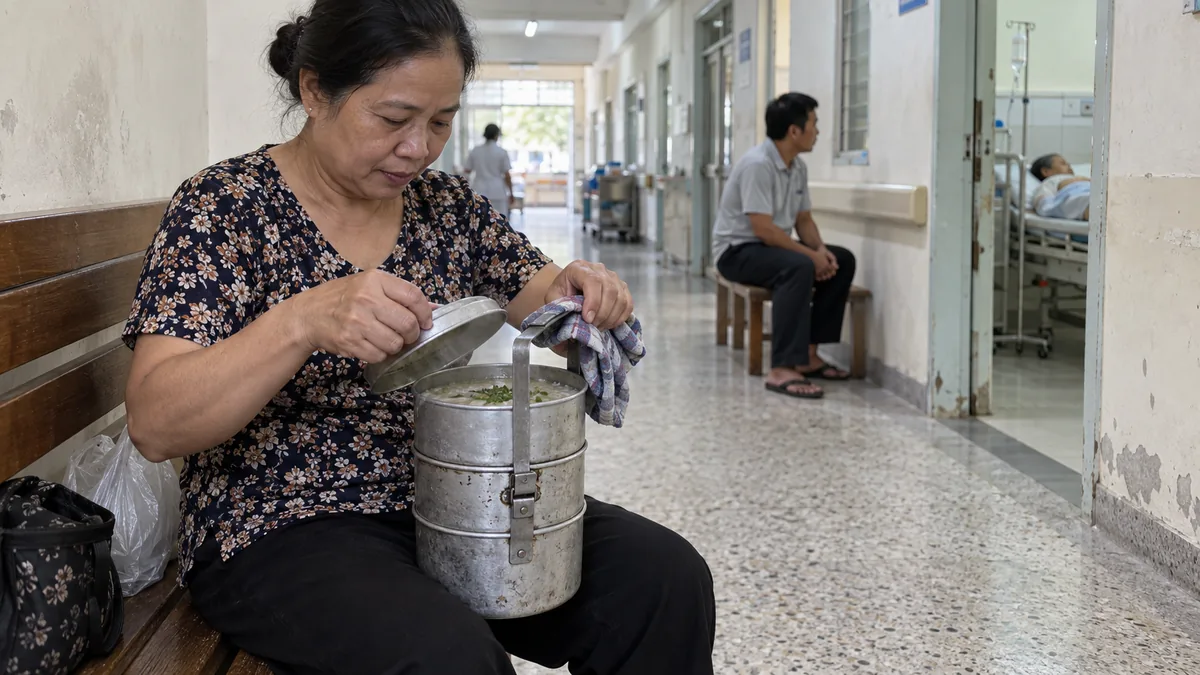
Carried as a vessel for porridge and pho in hospital wards
The author's first examples are the workplace at lunchtime and the hospital. Visitors carry a cà mên by hand, bringing home-cooked porridge or a warm bowl of pho from a familiar shop to the patient's room. The way the article is written, the very appearance of a cà mên looks like a sign of recovery. The idea of bringing food when visiting a hospitalized family member or colleague remains very much alive—a practical point for residents and business travelers alike.
The four- and five-tier cà mên of cơm tháng shops has also appeared as a film prop
In colonial-era Saigon, the cơm tháng shop—where customers paid a monthly fee for set meals—was a natural stage for the cà mên. The article cites an advertisement placed by Vi Tiên, a restaurant serving central Vietnamese cuisine, in the newspaper Trung Lập Báo. The address was 42 rue Amiral Courbet, the street now known as Nguyen An Ninh, and the ad promoted takeaway meals packed into a cà mên. A 1938 issue of the satirical paper Vịt Đực carried an illustration of a wife cycling to deliver her husband's lunch, stopping a race in the process. On the battlefield, soldiers painted the vessel black or wrapped it in cloth to prevent reflected light from revealing their position, and it served at once as storage, a cooking vessel, and a dish.
The cà mên in the cơm tháng shop in the film Quán Kỳ Nam comes in four and five tiers. The props are anodized aluminum with decorative patterns on the sides. The design overlaps with traditional Thai cà mên, and in Cambodia decorated versions are called chan srak and used as offerings during Pchum Ben or as gifts to monks. The practice of eating home-style food bought from a shop continues, and in Ho Chi Minh City it survives in changed form—for example in...A breakfast shop in an alley with 14 seats serving a meal with soup and three side dishes for around 300,000 dong—with a different pricing model but the same spirit.
How much does one cost? A look at actual online selling prices
Domestic stainless steel starts in the 100,000-dong range; Japanese brands reach into the millions
The prices below are listings on the shopping site Tiki searched under "cà mên" and "cặp lồng" as of September 26, 2026. Yen conversions use Vietcombank's telegraphic transfer buying rate for that day (1 yen = 160.34 dong), making 100,000 dong approximately 624 yen. Misreading the number of digits by one means a tenfold error, so count the trailing zeros when shopping in store.
| Type | Listed price (VND) | Yen conversion |
|---|---|---|
| Wheat-fiber type, 4 tiers | 61,999〜92,000 | Approx. 390–570 yen |
| Stainless steel, 3 tiers (1.4–2 L) | 109,000〜155,000 | Approx. 680–970 yen |
| SUS304 stainless, heavy-gauge with enhanced insulation | 299,000〜343,850 | Approx. 1,860–2,140 yen |
| Zojirushi SL-XE20-AD | 1,390,000 | Approx. 8,670 yen |
| Tiger LWU-F200 (1.48 L) | 1,559,000 | Approx. 9,720 yen |
Prices are set by individual sellers and do not include shipping; stock and pricing are subject to change. One interesting point: Japanese insulated lunch jars are sold in Vietnamese under the name "Cà Men." A word that came from a French soldier's mess tin now also refers to Japanese-made containers.
For plain aluminum versions, browsing market shelves is faster
The same search returns mostly insulated models, and the plain aluminum cà mên shown in the article's photographs is hard to find in major online catalogs. For those, the household goods section of a market or the shelves of a hardware shop is a quicker bet.
If buying as a souvenir, check the number of tiers, the clasp, and the thickness by hand
The names cà mên / cặp lồng / cà mèn / gà mên vary by region
The article notes that the vessel is also called cặp lồng, cà mèn, and gà mên depending on the region. Which term is understood varies by location, so being able to say all four will save confusion in a shop. To specify the number of tiers, "3 tầng" (number + tầng) gets the message across.
The right number of tiers depends on what you plan to put in it after you get home
The advantage of the tiered structure—the same reason the same design spread through Malaysia and Singapore—is that it keeps liquids and rice separate. For practical use, choose a heavy-gauge or stainless-steel model. The article's note that thin aluminum warps when dropped refers to the generic state-store variety, but it applies equally to souvenir-shop shelves. Being metal, it cannot go in a microwave; reheating means using a bain-marie or transferring the contents to a pot. For display, anodized aluminum with decorative patterns looks the part. Seeing the process before buying changes how you choose—the same is true of pearls, and...An article following the process at a Phu Quoc farm from caring for mother oysters through to processing—reading the two together changes how the price breakdown looks.
It has survived differently from India's dabbawalas
Mumbai built a delivery network from 1890; in Vietnam the vessel stayed in family hands
Vietnam is not the only place where Western military mess equipment entered civilian life. In India the same type of container is called a tiffin, and a network of delivery workers known as dabbawalas carries them. The Mumbai delivery service was started in 1890 by Mahadeo Havaji Bachche with around 100 people; collectors gather meals late in the morning and deliver them by bicycle and train, with empty containers returned after lunch or the following day—a system still in operation. India turned the lunchbox into an industry; Vietnam left it in the hands of families and individuals.
Next time you go to Vietnam, count the tiers at the household goods section of a market
Because the cà mên is inexpensive, which one you choose makes a real difference. Checking four things by hand—number of tiers, how firmly the clasp closes, thickness of the metal, and whether there is a decorative pattern—will tell you whether it is destined to be an ornament or a working object. Next time you visit Ho Chi Minh City or Hanoi, stop at a market's household goods section or a hardware shop before the souvenir stalls in tourist areas, count the tiers, and try fastening the clasp.