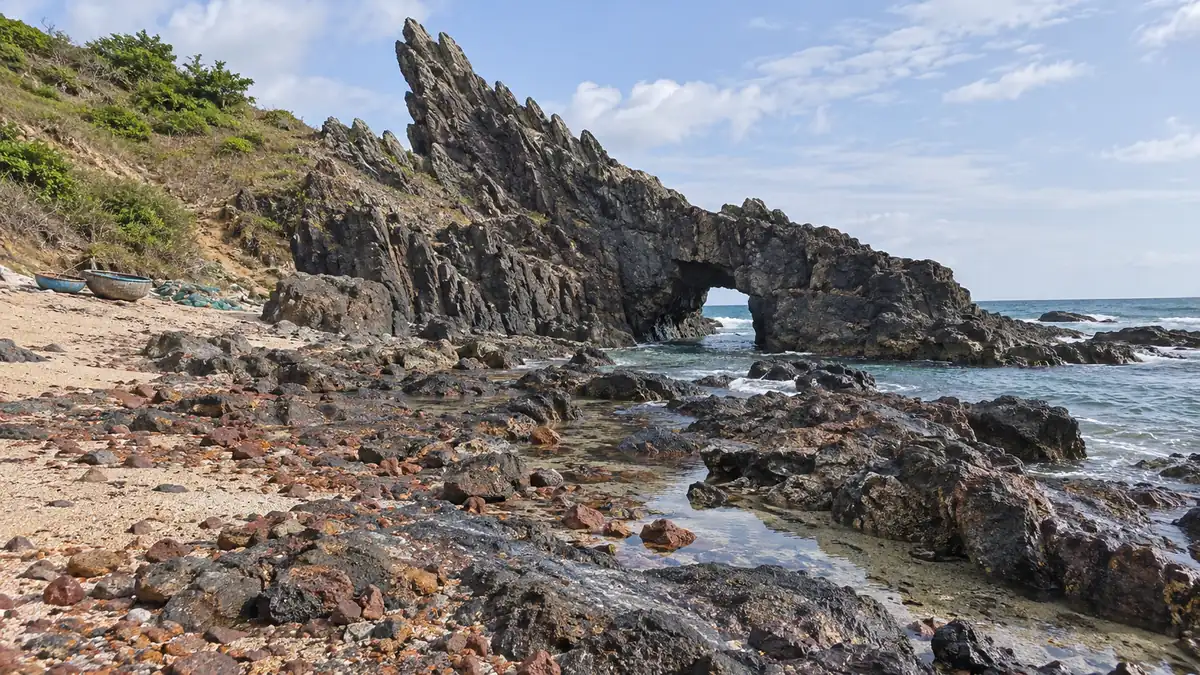
On the coast of Gia Lai Province in central Vietnam sits a cape known as the "Dragon's Fin," Mũi Vi Rồng. A cluster of jet-black rocks juts into the sea like breaking waves, and at its base a cave opens toward the water. Unlike the Eo Gio cliffs of Quy Nhon, which draw crowds with nighttime fireworks, this spot's appeal is its uncrowded quiet. With Gia Lai in the spotlight for the 2026 National Tourism Year, it's worth digging into why this still-little-known hideaway is worth the trip.
What's new about the much-reported Mui Vi Rong
What local media reported was the cluster of oddly shaped rocks on the coast of Tan Phuong in Phù Mỹ Đông commune, Gia Lai Province, called “Mui Vi Rongis presented as a popular destination for motorbike trips. Its rugged natural beauty, and a cave that pierces the rocky peak to open onto the sea, are drawing attention as photo spots. What stands out is how the location is described: not as the former Binh Dinh Province but as Gia Lai Province. Under the administrative reorganization, the coastline of the old Binh Dinh was absorbed into Gia Lai, and Gia Lai, long associated with highlands and forests, gained a coast. This cape is cited as a symbol of that shift.
The "Forest Touches the Blue Sea" Tourism Year and the Dragon Legend
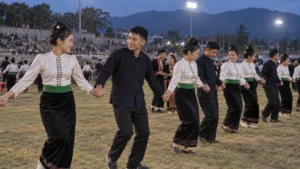
Gia Lai Province is hosting the 2026 National Tourism Year, under the theme "The great forest touches the blue sea (Đại ngàn chạm biển xanh)." It opened in Quy Nhon on March 28, with a full lineup of events scheduled through the year. The aim is to link the Central Highlands forests with the coast of former Binh Dinh in a single itinerary, and Mui Vi Rong ranks among the standout candidates on the "sea" side. A new forest destination on the inland, highland sideKon Ka KinhThe plan is to promote it by pairing mountainside spots like these with the coastal rock formations on the sea side.
It helps to know that Gia Lai has long been described as a “province without a sea.” As the gateway to the Central Highlands, its tourism has centered on coffee plantations, waterfalls, and ethnic-minority culture, while beaches belonged to other provinces. The administrative merger added the coastline of the former Binh Dinh, letting forest, highlands, and sea be bundled into a single administrative unit, and the tourism year's theme pushes that strength to the fore. Mui Vi Rong is the clearest embodiment of that shift—the province's new coastal face.
The cape's name comes from legend. As the story goes, the Tang-dynasty geomancer Cao Bien traveled the land severing 'dragon veins,' and used sorcery to cut down this rock where the energy gathered. The dragon's scales, scattered into the sea, became small rocks now called 'Da Vay Rong' (Dragon Scale Stones), and the dragon's blood, mixing into the sand, left behind vermilion pebbles. The climax of the tale is a cave that pierces the rocky peak out to the sea. At low tide you can walk the rocks up to the cave's mouth and, beyond it, take in a framed view of sea and sky. This whole area has been designated a Gia Lai provincial-level historic and scenic site as 'Mui Vi Rong–Tan Phung Mountain,' raising its standing as a destination a notch. Once you know the legend, the plain strange rocks start to look like the dragon's remains—that is the charm of this place.
Highlights and How It Differs from Eo Gio
It's easily confused, but the Eo Gio cliffs (Nhon Ly) near Quy Nhon and Mui Vi Rong are two different places. Eo Gio is close to the city, has well-kept walkways, and at nightFireworksa developed scenic spot that draws crowds. Mui Vi Rong, by contrast, is the coast of a fishing village well north of the town center, where the bare rocks remain with few railings or lights. It’s a spot for those who want to avoid the crowds and face nature itself.
| Item | Mui Vi Rong |
|---|---|
| Highlights | Dragon-shaped rock formations jutting into the sea, a cave piercing the rocky hill, and vermilion pebbles mixed into the sand |
| Type | Raw rocks with few railings or lights: a hidden beach next to a fishing village |
| Best season | The dry season with little rain (roughly March to August). Mornings, when the waves are calm, are easiest for walking |
| Access | About 70 km north of central Quy Nhon (approx.). About 20 km east of the town of Phu My (approx.) |
| How it differs from Eo Gio | Eo Gio is close to the city, developed and crowded; this spot is far, quiet, and undeveloped |
Local voices
Officials in Gia Lai Province's tourism and culture department, under a tourism-year plan that ties forest and sea into a single itinerary, are positioning coastal historic and scenic sites as new draws. Mui Vi Rong's provincial-level designation is part of that push.
Fishing residents of the Tân Phụng hamlet say this has long been a place for local fishing and worship, not somewhere built up for tourists. At low tide you can walk across the rocks toward the cave, but some warn that the footing changes once the tide comes in.
Travelers touring Gia Lai by motorbike note that while Eo Gio teems with people, here you can shoot photos with almost no one else in the frame. The appeal, they say, is exactly that raw, not-overly-groomed feel.
Practical information for Japanese visitors
Basing yourself in Quy Nhon is the practical choice. It sits roughly 70km north of the city center (just a rough guide), reached by car or rented motorbike along the coast. There is little public transport that drops you right at the site, so the safest plan is to take a bus toward Phu My and arrange a car or bike from there. For a day trip, leave in the morning and work backward so you arrive when the tide is out and the rocks are easy to walk.
Timing matters too. On the central coast, rain and typhoons concentrate from autumn into early winter, and rough surf can keep you off the rocks on some days. For both photogenic shots and safety, aim for a morning in the drier dry season. Check a tide table in advance and plan to walk the rocks at low tide, and the view around the cave changes completely.
The main thing to watch is the footing. Don't expect railings or maintained steps, and the rocks are slippery when wet. Wear non-slip shoes rather than sandals, and don't force your way around the cave. On days when the weather turns and the waves run high, be ready to give up on getting close. For what to bring, add snacks to water, sun protection, and a hat, since there are no shops nearby. The vermilion pebbles and rocks are part of the legend, so leave them in place rather than taking them home as souvenirs, out of respect for the scenery. Because a fishing village sits right next door, behaving quietly, with the awareness that you're entering people's living space, helps avoid friction with locals.
Nearby spots worth pairing
Along the same former Binh Dinh coastline, in the north that is now Gia Lai Province, events that put visitors in touch with simple fishing-village culture are on the rise, such as a sea festival held in the coconut town of Hoai Nhon.A festival of coconuts and sea in Hoai NhonPair a local festival like this with the strange rocks of Mui Vi Rong, and Gia Lai's 'other coast'—the one you can't see from the touristy beaches alone—rises up in your itinerary. Combined with the sights of central Quy Nhon, it's easy to plan a two-night, three-day route across mountains, sea, and fishing villages. Give one day to the polished scenery and a half-day to the raw hidden gem, and the difference in character stands out even within the same 'sea.'
Quy Nhon itself, the base for the trip, has filled out with hotels and restaurants in recent years and is increasingly ready to host Japanese travelers. Plan it so you head back to the city in the evening for seafood and set out for the Dragon's Fin the next morning, and the base's comforts make up for the remoteness of the hideaway. Being able to move back and forth between the developed and the untouched, the lively and the quiet, is what makes traveling the Gia Lai coast right now so appealing.
Summary
Mui Vi Rong is a secluded central-coast beach that brings together legend, strange rock formations, and a cave that opens out to the sea. Administrative reshuffling made it "Gia Lai's sea," and with the tailwind of National Tourism Year 2026 it is stepping into the spotlight. Still, its facilities are thin, and the quiet you can savor precisely because there are no crowds is part of its essence. Starting from Quy Nhon or Eo Gio and going a little farther to face the wild dragon's fin — it's well worth adding that leg to your itinerary.
Sources
- VietnamPlus, “Mui Vi Rong, a must-see scenic spot when you visit Gia Lai”
- Bao Gia Lai: “From the Cao Bien dragon-vein legend to a photogenic spot”
- VTC News, 'Mui Vi Rong–Tan Phung Mountain designated a Gia Lai provincial-level heritage site'
- Bao Chinh phu, "National Tourism Year Gia Lai 2026 'The Great Forest Touches the Blue Sea' Opens"