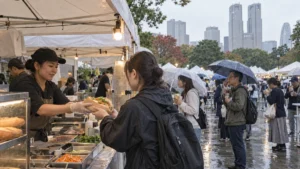
On June 17, 2026, in Ho Chi Minh City, the Ho Chi Minh City office of the Japan External Trade Organization (JETRO) and the Consulate-General of Japan in Ho Chi Minh City held a food-culture event featuring live washoku demonstrations. The consulate’s head chef, a goodwill ambassador for Japanese cuisine in Vietnam, and the Consul-General himself took the stage to introduce the “thinking behind the food”—dashi, seasonality, and hospitality. In Vietnam, where images of sushi and sashimi have led the way, the reception of Japanese cuisine is now being quietly updated. Let’s read this scene from the viewpoint of Japanese readers traveling in Vietnam.
What one evening in Saigon revealed
The event was hosted by JETRO’s Ho Chi Minh City office, which supports Japanese trade and investment, and the Consulate-General of Japan in Ho Chi Minh City. Behind the two joining forces on the theme of washoku is the aim to deepen mutual understanding between Japan and Vietnam through food as a gateway. Consul-General of Japan in Ho Chi Minh City Masuo Ono described the day’s purpose as wanting “to deepen mutual understanding through food and drink, strengthen friendship, and advance the two countries’ cooperation further.”
Giving the demonstration was Mr. Shuto, the consulate’s head chef. Grilling a wagyu steak, he explained that the ingredient kombu forms the foundation of washoku, and described the underlying philosophy as “reflecting the spirit of harmony at the heart of Japanese cuisine.” The venue served sautéed white fish with a sauce combining miso, yuzu, and lemongrass, sushi of salmon and tuna, and wagyu, while the words umami, respect for the seasons, and omotenashi (hospitality) were repeated. Washoku was inscribed on UNESCO’s Intangible Cultural Heritage list in 2013, and the day’s table took on the character less of a meal than of a cultural briefing.
From the “country of sushi” to the “country of dashi”—what’s new
The popularity of Japanese cuisine in Vietnam, especially in Ho Chi Minh City and Hanoi, has moved beyond the stage of a boom and blended into daily life. Residents and travelers well know that the area around Le Thanh Ton Street is called “Little Tokyo” and that Phan Van Chi Street has grown into a second Japantown. There, everything lines up, from casual set-meal eateries to high-end restaurants serving omakase courses.
What’s interesting about this event is that what was discussed wasn’t a push to “eat more washoku,” but an update in interpretation of “how to savor washoku.” Nguyen Ba Phuoc, a goodwill ambassador for Japanese cuisine in Vietnam who studied and worked in Japan for more than ten years, put it this way: “In the past, many people thought of Japanese cuisine mainly as sushi and sashimi. Now interest in dashi, omakase, kaiseki, and seasonal ingredients is rising.” He continued, “This shows that more Vietnamese consumers are beginning to see Japanese cuisine not merely as a dining option, but as a cultural experience.”
This remark can’t be lightly skimmed. Sushi is “a dish that’s easy to grasp visually.” There’s a topping, a form, and it photographs well. Dashi and kaiseki, on the other hand, are “dishes that are hard to see.” The umami of a bowl of clear soup, or the way a single dish conceals the season within its composition, is hard to notice unless explained. The fact that Vietnamese diners have begun turning their attention to that “invisibility” is the surest proof the market has matured.
Vietnam’s Japanese restaurants in numbers
The rising interest shows in the number of shops, too. According to 2024 data compiled and reported by the restaurant-information service Foody, the counts of Japanese restaurants in Vietnam’s major cities are as follows.
- Ho Chi Minh City: 944 shops
- Hanoi: 472 shops
- Da Nang: 111 shops
- Nha Trang: 42 shops
Ho Chi Minh City’s figure of 944 is nearly double Hanoi’s. Given that the coastal resort areas of Da Nang and Nha Trang have counts in the triple and double digits, it’s clear that washoku has spread beyond the frame of “for expats in big cities” into a dining option at tourist destinations. Note that this tally is Foody’s and is registration-based, so it should be read with a degree of caution. Even so, a scale approaching a thousand shops in the single city of Ho Chi Minh City tells clearly that washoku plays a part in this city’s dining-out culture.
Voices from the ground and the industry
From this event and the Vietnamese washoku scene behind it, voices from several different positions can be heard overlapping.
First, from the diplomatic front. Consul-General Ono positioning food as “a means of mutual understanding” shows that washoku is no longer merely an export product but is treated as a thread weaving Japan-Vietnam relations. When food rises to the diplomatic table, it’s also proof of being recognized as culture.
Second, from the chef’s standpoint. Just as head chef Shuto spoke of kombu while grilling wagyu, the maker shone a light not on a “flashy plate” but on the “foundational ingredient.” The stance of trying to convey the depth of dashi rather than the freshness of sushi echoes the shift in Vietnamese diners’ interest.
Third, from the standpoint of the bridge-builders. That figures like Phuoc, who trained long in Japan, stand between the local scene and Japan as “goodwill ambassadors” itself tells that Vietnam’s reception of washoku has entered the stage of “translation and taking root” from “import.” They aren’t selling sushi; they’re explaining the grammar of washoku in the local language.
What this means for Japanese travelers
From here, let’s think a bit further. What does the fact that washoku in Vietnam is broadening its interpretation toward “dashi, kaiseki, and a sense of season” mean for Japanese people who visit?
One thing is the mindset of “not underestimating local washoku.” When it came to Japanese food abroad, it was once standard to talk about “knockoff sushi” half as a joke. But the Ho Chi Minh City scene has long since passed that stage, with diners and makers growing who try to understand the context of omakase and kaiseki. When you step into a washoku shop on your trip, viewing it not as “a degraded copy of Japan” but observing “how Japanese food has been translated locally” raises the resolution of your travels a notch.
Another is the perspective that washoku becomes “a mirror reflecting Vietnamese food.” Vietnamese cuisine, too, shares a surprisingly close sensibility with washoku that values dashi and seasonality—in the fermented umami of nuoc mam and in expressing season and place through herbs. After tasting washoku at a Saigon table, savor home-style Vietnamese cooking in the same city and you’re sure to notice that the two are linked by the shared language of umami and season. Using washoku as a gateway to understand local food more deeply—that kind of back-and-forth comes naturally in this city.
Ripple effects on Japan-Vietnam dining and food exports
The crossover of food cultures doesn’t end on the table alone. Once Vietnamese diners begin turning to “ingredient quality” like dashi and seasonality, the ingredients in demand change too. There’s a chance that Japanese ingredients forming the foundation of washoku—kombu, katsuobushi, miso, soy sauce—will get more of a turn. From the stage of selling fresh fish for sushi to the stage of selling dried goods and seasonings that are the source of umami—you can see the groundwork advancing, through the accumulation of events like this, for exports to move up a phase.
On the dining-industry side, too, the winning path will split into two poles: “authentic” and “localized.” On one side, higher-priced shops that carefully convey the context of kaiseki and omakase. On the other, fusion-style shops that hew to Vietnamese palates. The “washoku as culture” that this event pushed forward is a tailwind for the former. Dishes whose value comes across through explanation grow stronger the more they have a place to be explained. For Japanese food-related companies, Vietnam is changing in character from “a market to win on numbers” to “a market to win on context.”
A perspective for enjoying washoku in Vietnam
Finally, let’s lay out some useful viewpoints for actually enjoying washoku in places like Ho Chi Minh City.
- Be aware of the shop type: A casual shop where sushi and sashimi are the stars differs in how it’s enjoyed from a higher-priced shop that touts omakase and kaiseki. The latter is a cuisine of savoring “the composition of each dish,” so eat unhurried and in order.
- Don’t rely on Japantown alone: Le Thanh Ton Street (Little Tokyo) offers a sense of security, but in recent years capable shops have spread to other areas too. Including streets growing into a second Japantown, don’t judge by location alone and you’ll find better encounters.
- Use umami and season as clues: Shops that promote dashi and seasonal ingredients are those consciously bringing out the “invisible value” of washoku. Whether the menu mentions a sense of season or dashi is one gauge of the shop’s stance.
- Savor it as a set with Vietnamese cuisine: Taste local home cooking before or after eating washoku, and the shared threads of umami and season rise up. Being able to travel between two food cultures in one city is a luxury unique to Saigon.
Summary
The washoku event held in Ho Chi Minh City on June 17, 2026, was not news of a flashy new opening. Yet it was an evening that made visible a quiet but large shift—that Vietnam’s once sushi-centered view of washoku is broadening toward dashi, kaiseki, and a sense of season. Cuisine rose to the diplomatic stage, a goodwill ambassador spoke of the grammar of washoku, and diners have begun receiving it as a “cultural experience.” For Japanese people traveling in Vietnam, this city’s washoku is changing from “confirming the taste of Japan” into the joy of confirming “how Japanese food has bloomed across the sea.” Saigon’s tables are on the front line where you can feel that change firsthand.
Frequently asked questions
Q. How popular is washoku in Vietnam?
A. It has taken root mainly in big cities. According to 2024 data compiled and reported by the restaurant-information service Foody, Ho Chi Minh City alone is said to have 944 Japanese restaurants. With 472 in Hanoi, 111 in Da Nang, and 42 in Nha Trang, it has spread to tourist areas too (source: Foody).
Q. Do Vietnamese people picture only sushi when they think of washoku?
A. Images of sushi and sashimi were once central, but according to Nguyen Ba Phuoc, a goodwill ambassador for Japanese cuisine in Vietnam, interest in dashi, omakase, kaiseki, and seasonal ingredients is now rising, and more people are coming to see washoku as a “cultural experience.”
Q. Where should I look to eat authentic washoku in Ho Chi Minh City?
A. The area around Le Thanh Ton Street is called “Little Tokyo” and gathers washoku shops, but in recent years capable shops have increased in other areas too. Choosing shops that tout omakase and kaiseki, or that put dashi and seasonality front and center, makes it easier to savor the depth of washoku.
Related reading
- SON, a wood-fired “home cooking” restaurant in Saigon, opens with a 100-dish table
- Banh u tro, Vietnam's lye-translucent Dragon Boat Festival rice dumpling, savored
- In a Thao Dien back alley, a former advertising director makes Tibetan momo dumplings
Source: