Hanoi authorities have fined en masse a group of food-and-beverage chains hugely popular with Vietnam's youth and students —Dookki (Korean-style tteokbokki), Laboong (bubble milk tea), and Com Tho Bach Khoa (an eatery near Bach Khoa University) —for food-safety violations. In a crackdown including popular locations like the Vincom Pham Ngoc Thach branch, Nam Thanh Cong in Lang district, and 28 Chua Lang Street, fines reached a maximum of12 million VND (about 70,000 yen).It's an event symbolizing a structural shift in Vietnam's food-and-beverage industry — a regulatory crackdown on the "photogenic," "Instagrammable" businesses favored by Gen Z.Tuoi Tre News. Here’s a summary of the coverage.
News detail: fines of up to 12 million VND across 4 shops
The health and market authorities of Hanoi's Kim Lien, Lang, Dong Da, and Vinh Tuy districts jointly carried out restaurant inspections in the latter half of April. The main shops caught and their violations are as follows.
| Shop name | Location | Fine amount | Violation |
|---|---|---|---|
| Dookki | Vincom Pham Ngoc Thach branch, Kim Lien district | 8 million VND (about 47,000 yen) | Drainage system stagnant and uncovered |
| Laboong | Nam Thanh Cong residential area, Lang district | 4 million VND (about 24,000 yen) | Lack of proper waste containers |
| Com Tho Bach Khoa | 28 Chua Lang Street, Lang district | 7.5 million VND (about 44,000 yen) | Business registration not filed |
| Golden Gate Group | Kim Lien district | 8 million VND (about 47,000 yen) | Drainage-treatment problem (same type as Dookki) |
Fine amounts were in a range of1.5 million to 12 million VND (about 9,000 to 70,000 yen)per shop, with several shops penalized in stages after re-inspection. The violations were basic food-safety items — inadequate hygiene management, improper waste disposal, unregistered business, poor food storage, staff not wearing protective gear, and so on.
Background: why businesses popular with Gen Z were targeted
Dookki is a Korean-origin self-service tteokbokki buffet chain with more than 40 stores across Vietnam. Its thriving branches inside Vincom-affiliated malls, with weekend lines, are a mecca for the young. Laboong is a bubble milk tea chain concentrating stores around university campuses, symbolizing Gen Z's after-school scene. Com Tho Bach Khoa is a mass-market eatery nearHanoi University of Science and Technology (Bach Khoa University),known as a lunchtime staple for students.
In other words, this crackdown takes the form ofdirectly hitting "shops that young people and students use daily."Behind it is the "food-safety monitoring of the youth scene" that the Vietnamese government has been strengthening since 2024. Because food-poisoning posts spread easily on social media and the impact on tourists is large, authorities set youth-popular shops as priority inspection targets.
Comparison with a similar case: the link to the contaminated pho noodle case
In Vietnam, food-safety crackdowns have come one after another from March to April 2026. Symbolic is thecase of 2,800 tons of contaminated pho noodles manufactured in Ho Chi Minh City,in which a couple were arrested for mixing in borax and liquid glass over 10 years. A suspected food-poisoning case affecting 46 people at an HCMC elementary school was also reported, and the authorities' crackdown is spreading across the food industry as a whole.
This Hanoi case differs in nature in thatnot "malicious adulteration" but "lax hygiene management"was the issue. All the more, it exposes a structural challenge in Vietnam's food-and-beverage industry, where even thriving shops violate basic hygiene and registration items.
Industry reaction: toward a review of chains' management systems
In Tuoi Tre News reporting, that Golden Gate Group (Vietnam unit) received a fine drew particular attention in the industry. Golden Gate is one of Vietnam's largest dining companies, operating many popular grilled-meat and shabu-shabu brands such as Gogi House, Kichi-Kichi, and Manwah.The fact that a major chain that "should have thorough hygiene management" was caughtcarries heavy meaning.
A local food-industry publication points out that "even if manuals exist, compliance at store operations is lax," and analyzes that drainage and waste-management problems in particular are "a structural issue where shops inside old shopping malls can't renovate." From here, hygiene audits of franchise members are likely to be strengthened.
Meanwhile, for independent small eateries (like Com Tho Bach Khoa), the violation was "business registration not filed," calling for more basic compliance. Many of Vietnam's individually run eateries are said to be in a similar situation, and an expansion of crackdowns is expected going forward.
Impact on Japanese travelers and residents
For Japanese travelers and residents, this case has two implications. First,"popular shop" does not necessarily mean "hygienic."In a situation where even famous chains inside Vincom malls are caught, a stance of checking a shop's cleanliness with your own eyes matters more than Tripadvisor ratings or the length of a line.
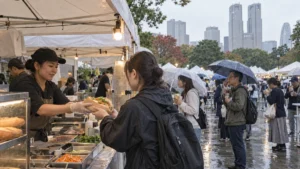
Second,The location of food-poisoning risk is shifting.Until now, Japanese travelers' food-poisoning countermeasures centered on rules of thumb like "indoors over street stalls" and "local shops over tourist areas." But this crackdown showed that popular chains aren't necessarily safe either.Like the Saigon Pizza Festival,Even at large events like these, advance confirmation of vendors' hygiene status becomes necessary.
Ripple effect on the industry: acceleration of the regulatory-tightening trend
The Vietnamese government has been advancing a revision of the Food Safety Law since 2025, considering raising the upper limit of fines and expanding the power to suspend operations. This12 million VND (about 70,000 yen) finelevel is close to the current law's cap, but after revision it's expected to jump to a scale of tens of millions of VND. Chains must be prepared for a heavier hygiene-investment burden per store.
Also, the Vietnam Standards and Consumers Association (Vinastas) began considering a "restaurant whitelist system" in April 2026. It's a mechanism to publish shops that pass inspection in an official app, and it could become a headwind for youth-popular chains like Dookki and Laboong.
Practical information: how to tell a trustworthy shop
| Item to check | How to check |
|---|---|
| Whether there's business registration | The "Giấy phép kinh doanh" number displayed at the storefront |
| Food-hygiene certificate | The "Giấy chứng nhận VSATTP" posted on the wall |
| Drainage and waste treatment | The state of the drains and covers at the kitchen entrance and behind the shop |
| Staff protective gear | Wearing masks, gloves, and caps |
| Ingredient storage temperature | The set-temperature display on the refrigerated case |
| Latest social media reviews | Posts from the past week on Foody, Riviu, and TikTok |
Summary: A turning point for Vietnam's dining scene
The mass crackdown on Dookki, Laboong, and Com Tho Bach Khoa shows that Vietnam's dining industry has moved from a stage of "youth-popular = anything goes" to a stage of "strictly questioning hygiene and registration regardless of scale." For Japanese travelers and residents too, the criteria for choosing a shop need to be updated from "photogenic" and "lines" to "hygiene certificate and registration."The contaminated pho noodle casecombined with it, the first half of 2026 is likely to be remembered as a turning point for Vietnam's food safety.