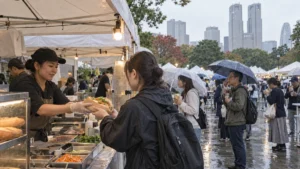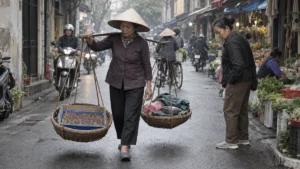
Cho Cu Market, located on Ton That Dam Street in District 1, Ho Chi Minh City. It's an old market that once spread along the canal connecting the Saigon River and downtown, and there's a stall that has kept serving hu tieu for over 60 years. It's a small corner at 69 Ton That Dam, run by shop owner Co Chanh (real name Huynh Thi Dung).
This stall, introduced in Saigoneer's popular "Hem Gems" series, was originally founded by Co Chanh's uncle. When her uncle emigrated abroad, he entrusted the shop to her. At first it served only Cantonese-style hu tieu, but responding to regulars' requests, the menu was expanded to hu tieu mi (with egg noodles), wontons, and meatballs.
The "unchanging taste" that supports 60 years of history
Co Chanh didn't attend cooking school. She honed her skills through daily practice and customers' reactions. "The recipe is just as I inherited it from my uncle. I don't do anything special," she says.
It's a taste unique to the Cho Cu district, which had many Cantonese residents. The broth, made from pork bones and dried shrimp, is clear with a deep richness, finished with Chaozhou vinegar and a house-made sauce. Toppings are shrimp, fried garlic, pork lard, liver, heart, and pork. You can choose between thick and thin noodles.
| Menu | Details | Notes |
|---|---|---|
| Hu tieu mi | Cantonese-style soup with egg noodles | Thick or thin noodles selectable |
| Hu tieu | Rice-noodle soup | Staple menu |
| Wonton | Cantonese-style wonton | Can be ordered on its own |
| Meatballs (bo vien) | With Chinese spices | Also sold wholesale to other shops |
The rise and fall of Cho Cu Market
Cho Cu on Ton That Dam Street originated in the 19th century as a place where Chinese and Indian merchants traded along the Cho Vai canal connected to the Saigon River. In 1887, the French colonial Saigon administration filled in the canal to improve sanitation, and the merchants relocated to what is now Ton That Dam Street.
Historian Vuong Hong Sen, in his 1960 book "Sai Gon Nam Xua," recorded Cho Cu as "a place to eat the best fish congee (chao ca)." The food culture of the Cantonese community remained strong, and famous Chinese-cuisine spots that rivaled those of Cho Lon (Chinatown) were dotted about.
| Era | Cho Cu event |
|---|---|
| First half of the 19th century | Chinese and Indian merchants gather along the Cho Vai canal |
| 1887 | The French colonial administration fills in the canal; relocation to the current site |
| 1960s | Co Chanh's uncle opens the hu tieu stall |
| Peak period | Selling over 100 bowls a day |
| Now | Down to about 30 bowls a day, as the market keeps shrinking |
Local voices
- Co Chanh: "Now 30 bowls a day is a stretch. Some days I can't even cover the cost of ingredients."
- A regular (an office worker nearby): "Coming during my lunch break has been a habit for 15 years. It's trustworthy that the taste never changes."
- Co Gai, who sold sweets next door: "I used to sell sweets next door. Ever since then, we've worked together like sisters."
What it means for Japanese travelers
On a Ho Chi Minh City trip, Ben Thanh Market and Bui Vien Street are the standards, but few travelers venture as far as Cho Cu. Though it's about a 10-minute walk from the center of District 1, you can experience a "local kitchen" with no tourist-oriented staging.
Hu tieu is a representative noodle dish of southern Vietnam alongside pho, but shops that serve it in the Cantonese style are decreasing. For travelers seeking a bowl not listed in guidebooks, Co Chanh's at Cho Cu is not to be missed.
The latest gourmet scene in Ho Chi Minh City is also introduced here
Ripple effects on the dining industry
In Ho Chi Minh City, street stalls and small shops in old markets are rapidly disappearing due to redevelopment and soaring rents. Cho Cu Market is no exception, and the construction of surrounding buildings has changed the flow of customers.
On the other hand, the presence of media that record and share such long-established stalls, like Saigoneer's "Hem Gems" series, is drawing attention. Even within Vietnam, debate is heating up that street-stall culture should be protected as "intangible cultural heritage of food."
For more on Vietnam's street-food culture, also refer to this
| Item | Details |
|---|---|
| Shop name | Co Chanh's hu tieu stall (no formal shop name) |
| Address | 69 Ton That Dam, Ben Nghe, District 1, HCMC |
| Hours | About 4 a.m. to 7 p.m. (ends when sold out) |
| Closing days | Irregular |
| Price range | About 65,000 VND (about 390 yen) |
| Nearest landmark | A 5-minute walk from Calmette Bridge |
| Google Maps | Search for "Ton That Dam Cho Cu" |
Summary
Co Chanh's hu tieu stall has kept operating for 60 years with hardly a change to its menu or location. The reality of dropping from 100 bowls a day at its peak to 30 reflects Saigon's rapid urbanization. Even so, the sight of her starting prep at 4 a.m. every morning is the last bastion of Cho Cu Market's Cantonese food culture. If you visit Ton That Dam Street, try this bowl that remains in the valley of the high-rises.
See here for notable restaurant information in Ho Chi Minh City