At 5 a.m. before dawn, on the summit of Nui Cam (Thien Cam Son) in An Giang Province in southern Vietnam, there's a market that appears for only a few hours. A deep fog wraps the vegetables and river fish on the carrying poles in white, and the whole market literally sinks into the clouds. Locally it's called "Cho May" (cloud market) and is known as the highest-elevation morning market on the flat, watery lowlands of the Mekong Delta. It's a moment where daily life itself becomes scenery, one you won't meet just by touring the standard sights. For Japanese travelers looking for "an experience one step off the standard," this is a hard theme to overlook.
A "market in the clouds" that appears for only a few hours
According to reporting by the local paper Tuoi Tre and others, Cho May is held in the mountaintop hamlet of Nui Cam. The market gets moving around 5 a.m. and is packed up around 9 a.m. At 4 a.m., while it's still dark, Khmer women living at the foot of the mountain start climbing the slope carrying vegetables and wild greens. By the time they finish laying out their goods, the morning fog reaches its thickest, and the market is swallowed into a white sea of clouds.
The name "cloud market" comes from this very natural phenomenon. Because the dense fog covers the mountain slope and the market appears to float within the clouds, people came to call it that without anyone deciding to. There's no set sign or opening bell, and it disperses naturally as the fog lifts. The heart of this place is that it's not a market staged for tourism but the everyday shopping ground of the people living on the mountain.
Wild greens, river fish, and local sweets line the carrying poles
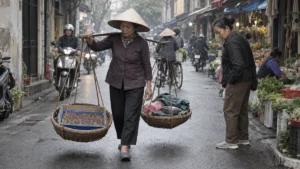
What's lined up isn't tourist souvenirs. Wild greens gathered in the mountains (rau rung), river fish and meat, the fermented seasoning mam essential to the southern Vietnamese table, incense and candles, seasonal wild fruits, simple local sweets, and even small fish used for releasing life (放生) at temples. Goods piled to overflowing on rough shoulder poles (ganh) are dotted through the fog.
There are around 50 stalls. Unlike markets arranged for tourists, prices aren't standardized, and the distance between seller and buyer is extremely close. Reports say many visitors strongly remember "the intimacy and quiet felt while eating breakfast in the fog." You could say it's a market where you carry home the air of the place rather than the goods themselves.
The geographic backdrop of "the roof of the Mekong Delta"
Why can a market form on a mountaintop? The key lies in Nui Cam's geography. Among the "Seven Mountains" (Bay Nui / That Son) running through the Tinh Bien and Tri Ton area of An Giang Province, Nui Cam, at about 710 m, is the highest and is the highest peak in the entire Mekong Delta. Because the surroundings are flat watery lowlands as far as the eye can see, this mountain alone has a cool highland climate and has long been called "the Da Lat of the Mekong Delta."
The "cam" (禁) in the mountain's name has a historical origin. When Nguyen Phuc Anh (Emperor Gia Long), who later became the first emperor of the Nguyen Dynasty, hid on this mountain while fleeing the Tay Son army, he forbade people from entering, and so it came to be called "the forbidden mountain." Today about 3,000 people still live on the mountain, and a 26.5 m statue of Avalokitesvara stands there. It's a mountain of faith and tourism visited by about 1,000 people a day, and you begin to see the structure whereby the morning market functions as the livelihood base of those residents.
Cho May by the numbers
| Item | Details |
|---|---|
| Elevation | About 710 m (the highest peak, Bo Hong, is about 716 m) / the highest peak in the Mekong Delta |
| Hours | Around 5 a.m. to around 9 a.m. (most dreamlike from 5 to 7) |
| Number of locations | Around 50 stalls |
| Main sellers | Khmer residents from the foot of the mountain (mostly women) |
| Main goods | Wild greens, river fish, mam, incense, seasonal fruit, local sweets, small fish for releasing life |
| Mountaintop population | About 3,000 people / around 1,000 visitors a day |
These figures are limited to what could be confirmed across multiple Vietnamese local media and geographic sources. Reports give the elevation a range of 710-716 m, but this is a difference of whether you take the base point from the foot or the highest peak Bo Hong; the positioning as "the highest peak in the Mekong Delta" is common to all.
Voices of visitors and sellers
Local reporting and travelogues reveal how this market is received. In summary, the following reactions stand out.
- Voices enjoying how its face changes with the weather: the foggier the day, the better, with the market sinking into cloud and only the shadows of the carrying poles floating into view.
- Voices praising the simplicity: it's good that it isn't touristified, with no price tags or flashy hawking, just the life of the foothills laid out as-is.
- Renewed attention from the social-media generation: for the young "cloud hunting" (san may) crowd, it delivers both photogenic scenery and a morning market visit at once.
In other words, while it's a local market of daily life, the visual strength of the sea of clouds has begun to get it doubly consumed as a "photo spot" for young Vietnamese tourists too. Just like the case of Hue's ruins turned into a photo spot (Hue's ruined water park, a giant dragon photo spot), Vietnam continues to see "places not originally meant for tourism" become famous via social media.
Value and access for Japanese travelers
The meaning of a Japanese traveler visiting Cho May lies not in "buying things" but in "adding a different texture to the standard Mekong Delta itinerary." If cruises and floating-market tours are a horizontal, watery lowland experience, Nui Cam is the contrasting experience of climbing vertically to stand on a foggy highland.
Access is easiest to grasp in stages. First, from Ho Chi Minh City to the Nui Cam area is about 231 km, 5 to 6 hours by bus or car. Basing yourself in the border town of Chau Doc brings you much closer, about 37 km to the foot of the mountain from there. Chau Doc is a tourism hub known for its floating villages and the sacred Sam Mountain, so a plan that spends one night here is realistic.
To the summit, you take either the 3.5 km cable car (about 15 minutes) or the mountain road by motorbike or car. The cable car runs roughly 300,000 VND round trip for adults as a guide, but since fares are revised, checking the latest info is a prerequisite. The issue is timing. Since the market's peak is 5 to 7 a.m., the realistic solution is to stay overnight at the foot or to stay at a mountaintop temple lodging or guesthouse the night before and greet the morning there. Even if you go up from the foot on a day trip, you'll likely see only "just a hamlet" after the fog has lifted.
The best season is the early morning of the dry season, when fog forms easily and mornings are cool. The rainy season (roughly May to November) lets you enjoy it alongside the Mekong Delta's flooded scenery, but the footing is bad and visibility is hard to read. The Chau Doc area also has warnings about pickpocketing, so if you're moving in the dark early hours, it's safest to carry minimal cash spread across different places. As an itinerary crossing the Mekong Delta, it's easy to combine it with Can Tho's floating markets and warm-hearted food culture (Can Tho's 60-year-old couple's free eatery) and set a westward route of "Can Tho -> Chau Doc -> Nui Cam."
Ripple effects on tourism trends
The renewed attention on Cho May shows that Vietnam tourism's center of gravity is broadening from "famous stunning views" to "early-morning experiences where daily life is visible." While Ha Long Bay cruises win worldwide acclaim (Ha Long Bay cruise makes the world's top 10 experiences), the travel-savvy crowd has begun seeking "times and places not yet worn smooth by tourism." Early-morning markets, fog, local carrying poles, these elements make photographic differentiation easy and pair well with social media.
At the same time, the dilemma that "a market of daily life becomes a spectacle" as tourists increase is unavoidable. Cho May's appeal lies in its unstaged simplicity, so whether visitors can behave quietly in step with the locals' rhythm of life will shape this place's lifespan. For a Japanese traveler, engaging by actually buying some wild greens or local sweets, even a little, and taking them home, is a behavior that ultimately supports the market's continuation, not just shooting photos.
Practical info summary
| Item | Guide | Notes |
|---|---|---|
| Location | The mountaintop hamlet of Nui Cam, An Giang Province | The highest peak of the Seven Mountains (That Son) |
| Market hours | Around 5:00 to 9:00 | The fog is beautiful from 5 to 7. Staying overnight in advance recommended |
| From HCMC | About 231 km / 5 to 6 hours | Bus or car. Via Chau Doc is standard |
| From Chau Doc | About 37 km | Ideal as a base for staying overnight in advance |
| Way up | Cable car 3.5 km (about 15 minutes) / motorbike or car | About 300,000 VND round trip for adults as a guide. Fares require checking the latest info |
| Best season | Early morning in the dry season | The rainy season has great flooded scenery, but watch your footing |
| Points to note | Spread out your cash, dress warmly, slippery paths | It's cold early in the morning. When shooting photos, be considerate of the locals |
Summary
Cho May, the cloud market that appears for only a few hours on a 710 m summit, adds an incongruous layer of highland and fog to the Mekong Delta's "journey of water." Precisely because it isn't arranged for tourism, the foothill life and the mountain of faith rise up just as they are. If a Japanese traveler visits here, rather than heading up on a day trip, the key is the setup of staying overnight in advance at Chau Doc or the foot of Nui Cam and heading into the fog while it's still dark. As a place where Vietnam's "photo-worthy" and "daily life" intersect, I'd recommend it to anyone seeking a quiet morning experience, different again from the heat of a street-food festival (A line of carrying poles on Da Nang's beach, a street-food festival with over 70 stalls).
Sources:Tuổi Trẻ Online「Độc đáo chợ mây trên đỉnh núi Cấm」 / VietnamPlus「Chợ Mây – phiên chợ độc đáo trên đỉnh Núi Cấm」