
For just eight days in high summer, young voices returned to a small village on Hanoi's outskirts. Beside artisans lacquering, turning the potter's wheel, and manipulating water puppets, university students held up their phones to film video. The design camp "Summer Camp Re:Craft 2026," held in July 2026, sent more than 100 students into five craft villages where successors are dwindling. The digital content they made passed 310,000 views, turning fading handwork all at once into "heritage that gets seen."
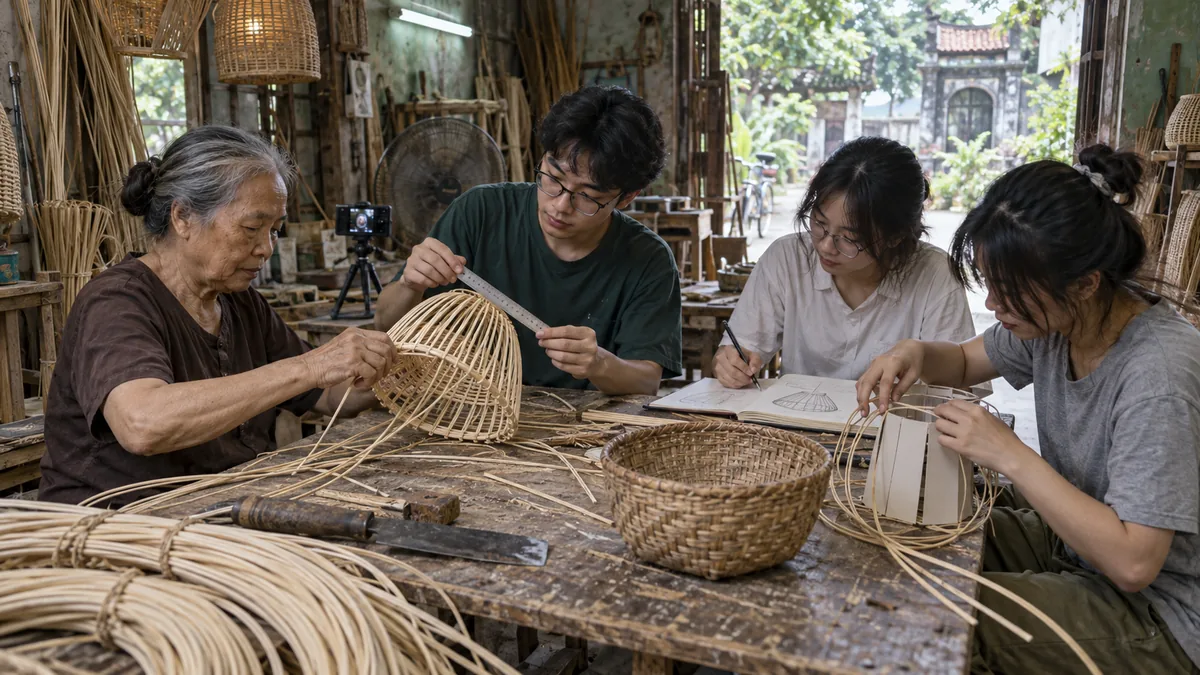
This isn't someone else's problem for Japanese production regions wrestling with how to pass tradition to the next generation. In how Vietnam's young people closed the distance to traditional crafts, there's an approach worth learning from.
What is "Re:Craft 2026," launched by Hanoi Architectural University
Re:Craft 2026 is a summer camp hosted by the Hanoi Architectural University, gathering students from 11 universities in the north, including the Hanoi University of Culture and FPT University. It opened on July 6, and after eight days of field research and residential production, the results were unveiled on July 13 as part of the Hanoi Creative Design Festival 2026. UNESCO and UN-Habitat are also among the organizers.
The camp was built on four pillars: "Re:Design" to rethink the products themselves, "Re:Brand" to put the villages' value into words, "Re:Create" to shape them into something sellable, and "Re:Connect" to deliver the story through video. Living and eating alongside the artisans, the students heard out the materials, techniques and challenges the villages face, and came home with prototypes and footage. Interactions on social media reportedly topped 10,000.
The craft villages dotting the outskirts of Hanoi, and the quiet advance of the successor shortage
On Hanoi's fringes, many villages remain that have kept a single handcraft alive for centuries—lacquerware, ceramics, rattan weaving, embroidery, water puppetry. Once the whole village passed down the skills and met the city's demand. But younger generations leave for urban wages and stability, and the pattern of workshops left with only aging artisans is spreading. Labor-intensive crafts can't win on price against mass-produced or imported goods, and as demand thins, the reason to carry on the skills fades too. This negative spiral takes almost the same shape as what Japan's traditional industries have faced.
Re:Craft chose the five villages richest in both technique and story. Students embedded in each village and, rather than mere tourism PR, dug into "why this village's craft still holds value today." Their fieldwork gathered everything from where materials come from to the labor of each step and the real state of generational succession, and only then did they move to prototypes and video production. It's a whole different depth of engagement than filming a tourist site from the outside.
The five craft villages the students entered, and the new attempts
| Village | Traditional crafts | New attempts at the camp |
|---|---|---|
| Ha Thai (Ha Thai, *distinct from Ha Tay Province) | Lacquerware | Redesigning into contemporary products that make use of lacquer's texture |
| Kim Lan (Kim Lan) | Ceramics | Putting a kiln's story into words as a brand and sharing it |
| Dao Thuc | Water puppetry | Filming that conveys the appeal of the performance in short videos |
| Phu Vinh (Phu Vinh) | Rattan and bamboo weaving | Turning weaving techniques into everyday goods as products |
| Quat Dong | Embroidery | Rebuilding a brand around the handcraft of embroidery |
What they had in common was translating tradition into a form that works in today's life and on screen, rather than displaying it as is. Filming the artisan's hands up close, keeping the sound of the tools, subtitling the maker's words. The moment it's rephrased into the grammar young people use, handwork that looked plain flips into something "moving."
The camp's impact, as told by the judges and organizers
Bui Thi Thanh Huong, editor-in-chief of the architecture magazine Kien truc, who judged the final presentations, framed the students' work this way.
"The expert judges evaluated these not as mere workshop assignments but as early-stage project proposals that can be further refined, tested in the field, and developed going forward."
He also left remarks on the camp's design philosophy.
"The summer camp was built as an ”open creative workshop”—a place where artisans, designers, instructors and students research, dialogue and create together."
The organizers flew the theme 'awaken new vitality in traditional craft villages.' Rather than fencing off crafts as objects of preservation, they renew them together with young makers - that stance is the decisive difference from a one-off PR event.
Japan's traditional industries, and takeaways for readers
In Japan's producing regions too, Wajima lacquer, Mino ware, and various sashiko and bamboo crafts face the same successor problem. Government subsidies and better treatment for artisans are essential, but what Re:Craft showed is another entry point. The more solemnly you speak of tradition as "something to protect," the more the distance from the younger generation widens. Rather, when outside students film it and retell it, appeal that the insiders hadn't noticed becomes visible.
What works here is the idea of separating the maker from the storyteller. Asking artisans to handle promotion too is a heavy burden. Pair those with the skill and young people who can translate it into the language of the screen, and each can focus on what they do best. There's ample room for Japan's production regions to open their workshops to students or outside creators and entrust them with short videos and brand design. Travelers and consumers, in turn, by encountering stories retold this way, can receive the village time behind a single vessel or a bolt of cloth.
Another point not to miss is the mechanism that keeps the results from being a one-off. In Re:Craft, students' prototypes were treated as "early-stage proposals that can be developed further," connected to a showcase in the form of a design festival. When outside young people engage with a region's crafts, nothing stays in the village if it ends with a single workshop. Preparing an exit for continued involvement is what separates turning a "related population" into an actual reserve of future practitioners.
As a traveler, to visit these craft villages
All five villages are within a day trip of Hanoi. Ha Thai, known for lacquerware, and Kim Lan for ceramics are about an hour by car from the city center, and Quat Dong for embroidery and Phu Vinh for rattan weaving sit in nearby areas too. Dao Thuc is known as a home of water puppetry, where you can watch a performance. To tour on your own, a taxi or ride-hailing app is realistic, and it's safest to contact the workshops in advance.
Around Hanoi, there are other such handcraft hometowns scattered about. From Dong Ho village, known for woodblock prints, to ethnic-minority villages that preserve embroidery and medicinal-herb culture, many places can be visited in half a day to an overnight. Just extend your steps a little from the city's bustle and you can witness the site of handwork that mass-produced goods can't offer. Work just one into your itinerary and the resolution of your Vietnam trip goes up for sure.
See also our related article on touring the villages.
- To Dong Ho, Vietnam's Ukiyo-e Village: A Half-Day Printmaking Experience From Hanoi
- Stay with the Red Dao people's herbal baths and embroidery in Ta Phin village near Sa Pa
- Teachers and office workers alike: the night young people revive don ca tai tu in a bar
Summary
Re:Craft 2026 was an experiment that sent over 100 students into five fading craft villages and retold tradition in the youthful language of social media. More than 310,000 views show that handwork hadn't grown old—only the way it was told had. Separating maker from teller and inviting in an outside perspective—this approach can apply to Japan's own production regions facing the same succession problem. For travelers, too, these villages are sites of living heritage you can reach with just a short trip out from Hanoi.