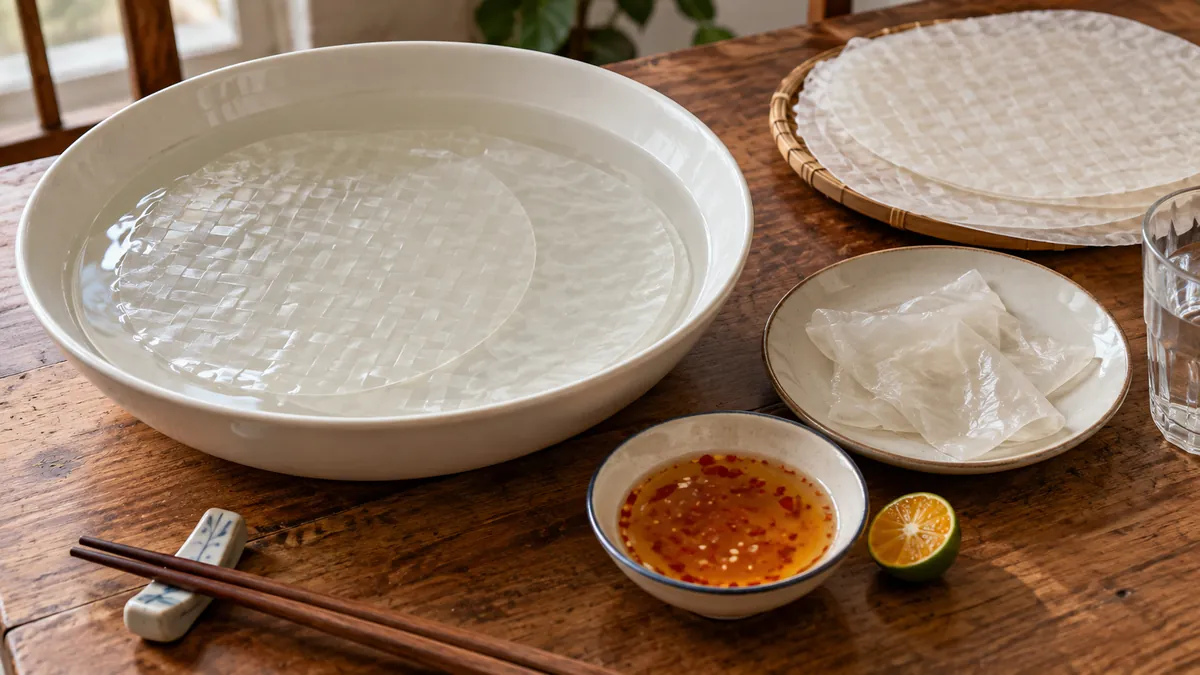
Bánh tráng nhúng nước — stacking several sheets of rice paper, soaking them in water, and dipping the softened result in sauce — became a talking point on Vietnamese social media in early 2026. Unlike fresh spring rolls, which are wrapped around fillings, this is a simple snack that puts the chewy texture and dipping sauce front and center. Rather than the birth of a new regional dish, it is more accurate to see it as a trend that took the long-established practice of rehydrating rice paper in water to an extreme for social media.
What Went Viral
According to Thanh Niên, a cooking account with around 400,000 followers posted content that accumulated roughly 7 million combined likes, comments, and shares across multiple platforms. That figure does not mean 7 million purchases or visits. The ease of experimenting with different combinations — a salt-and-kumquat dipping sauce, fermented shrimp paste, soy sauce, condensed milk, coconut milk — is thought to have worked well with the spread of video content.
An Arrangement to Enjoy the Texture, Rather Than a New Dish
Vietnam has long had a tradition of rehydrating rice paper in water and wrapping it around meat and vegetables. What sets this trend apart is softening several sheets together and eating them with almost nothing else. Interviews also turned up opinions such as "it all depends on the sauce" and "I've been eating something similar for years," and reactions were mixed. The fact that something is trending on social media does not guarantee it will taste good; trying a small amount to get a feel for the texture is probably the right approach.
Things to Keep in Mind When Trying It at Home
- Use rice paper intended for fresh spring rolls that is labeled as requiring no cooking
- Rehydrate with drinking water and do not leave it at room temperature for extended periods
- Do not stack too many sheets at once, and eat pieces small enough not to cause choking
- Be aware of crustacean allergies and hygiene conditions when using fermented shrimp paste
- Condensed milk and store-bought sauces are high in sugar and salt, so use them in moderation
When choosing a street stall while traveling, check whether the water used for soaking and the utensils are clean, and whether the sauce has been left out at room temperature. If you have concerns, it is safer to choose a busy stall where you can see the preparation, or a stall with clearly visible hygiene practices.
How I would check things on the ground
For restaurants and food, I look at the condition of the shop rather than its reputation. I would check the price list, cooking and storage practices, how busy it is, and the ingredients, and if something seems off, I would choose a different shop or order a smaller portion. Since opening hours, prices, and menus change, I would not insist on old information when talking to staff. For food to bring home, even if it is pre-packaged, I would confirm Japan's animal and plant quarantine and customs conditions.
Sources & Related Articles
- Thanh Niên: 2026 Social Media Trend
- Spread of #StandBanhMi
- Kienthuc.net.vn, "Bánh trung thu vào mùa sớm" (published July 17, 2026)
Check Before You Eat or Take Away
Confirm prices at the in-store VND display, portion size, and any additional charges. For raw or room-temperature items, check turnover, temperature control, sealing, and production date, and also check for allergens such as seafood, peanuts, soy, and dairy. For food and plants brought back to Japan, quarantine conditions vary by item and processing method, even for packaged goods.
Also, consider separately who this article is suited for and who it is not. The best choice varies depending on time, budget, physical condition, language ability, and the ages of those traveling with you. Having one alternative plan ready means that if something sells out, the weather turns bad, a venue is closed, or there are delays, you can avoid pushing yourself too hard.