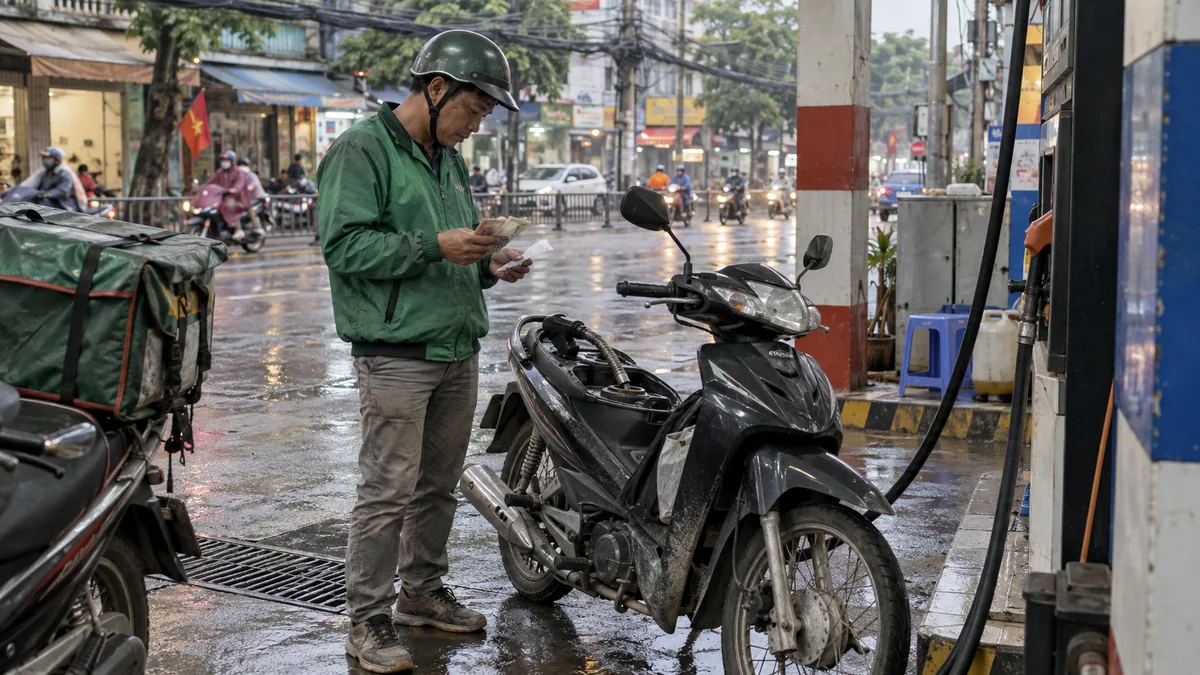
News in Vietnam has reported Grab drivers, centered in Ho Chi Minh City, calling for a switch-off — “turn off the app on September 12 and 13 and stop working.” The example cited as emblematic is a driver's post saying that after completing an 18.5km trip, only 46,900 dong made it into their hands. For residents who use ride-hailing apps day to day, this could mean cars and motorbikes are harder to book on those two days. Here we break down, using only the figures that have been reported, how ride-hailing fares are split between drivers and the platform, and think through how to plan your travel over those two days.
18.5km for a take-home of 46,900 dong: what's being called into question
The story starts with a driver's complaint reported by Tuoi Tre on September 9. Driving 18.5km on GrabBike's savings plan (GrabBike Tiet Kiem), the driver's take-home came to just 46,900 dong. Divided by distance, that's roughly 2,530 dong per kilometer — the amount shown on the app before deducting gas, vehicle wear, and maintenance costs. The drivers' argument comes down to a single point: the distance driven and the actual take-home don't add up.
As this kind of complaint spread across several driver groups, the call to “turn off the app and protest on September 12–13” gained traction. That said, Tuoi Tre itself cautions that these individual cases don't necessarily represent the whole.
A driver's take-home swings a lot from ride to ride
The following day, September 10, Tuoi Tre published another article with concrete examples of how actual rides were split. These are a small number of cases, but they show that even within the same Grab platform, the share drivers take home varies significantly ride to ride. Below are the figures as reported in each article.
| Case | Total fare (dong) | Driver's share | Platform fee, etc. |
|---|---|---|---|
| GrabBike savings plan, 18.5km | — (undisclosed) | 46,900 | Breakdown undisclosed |
| One example of what a passenger paid | 37,000 | 19,500(52.7%) | 5,000 fee + optional Ride Cover 2,000, etc. |
| Electric car, 3.98km, 4 passengers | 47,840 | 26,650(55.7%) | 21,190(44.3%) |
| Gasoline car, about 37km | 552,240 (including 44,000 in tolls) | 324,457 | 182,023 |
| Electric car, short distance | 66,000 | 57,000(86.4%) | 8,640(13.6%) |
Even under the same “Grab” brand, the driver's take-home share ranges from 52.7% to 86.4%. But these are a small number of cases under different conditions, so it's not possible to pin the variation on a single cause. The figures in the table are exactly as each article reported them, and since tolls, taxes, and optional service charges are mixed in, each row doesn't reduce to simple arithmetic. What a passenger pays includes not just the fee deducted from the driver's share, but also items the passenger chooses optionally, such as Ride Cover (insurance-like coverage, 2,000 dong in this example).
Grab says operations are “normal” — reading both sides together
Grab, for its part, told Dan tri on September 10 that it was “aware of some of the information and discussion” around the call to turn off the app, but explained that its service has been operating as usual recently. The company said, “Indicators around service quality, driver activity, and the platform remain at a stable level,” and urged drivers to check official channels for information. It didn't mention specifics on how many drivers might be affected.
But what Grab addressed was the state of service operations — it didn't weigh in on whether the fee level, or a take-home of 46,900 dong, is fair. In other words, right now there are two separate points sitting side by side: the fact that some drivers are voicing dissatisfaction and calling for a work stoppage, and the platform's own view that operations are running normally. It's too soon to look at just one side and conclude that “ride-hailing will definitely be unavailable on the 12th and 13th.” How much the actual driver turnout drops won't be clear until the day itself.
What's in a ride-hailing fare, and what squeezes driver income
Ride-hailing platform fees are said to go toward behind-the-scenes costs like matching, payments, support, and running the system. What looks like money being “taken” from the driver's perspective is also, from the passenger's perspective, the price of the convenience of a car showing up minutes after opening the app. Seen through that dual lens, the real issue isn't a simple “is the fee too high or not” but a question of adjustment: how transparent is the income, and how should the split be designed as fuel and vehicle costs rise.
In fact, platform fees aren't the only thing squeezing what drivers take home. Fluctuating fuel prices feed directly into the math of every single ride. In Vietnam,the pump price of E10 gasoline climbing to the mid-20,000-dong rangehas also been a factor, and once you subtract fuel costs from that 2,530-dong-per-km take-home, what's left in hand gets even thinner. Looking at the “real profit per kilometer,” including fuel and maintenance, makes more sense of the drivers' frustration than looking at fee figures alone.
Shifting ride-hailing fares are part of this summer's broader rise in living costs
This whole episode around ride-hailing fares connects to a broader rise in the cost of living that's continued since this summer. Just likeSeptember's hike in household gas pricesaffects people who cook at home, anda string of revised bank feesaffects anyone with an account, breaking down a confusing fee structure yourself is, in itself, a way to protect your household budget. It's worth knowing how a fare shown on screen actually gets split between the driver and the platform, so you can stay calm and judge clearly when a fee hike or service change comes along.
How to plan your travel on September 12–13
It's unclear how far a work stoppage would actually spread, but as a resident, it's safer to plan around the premise that “cars might be harder to catch.” Morning and evening peaks, and rainy periods especially, already tend to stretch ride-hailing wait times even on a normal day. Here are practical precautions so you're not caught off guard on the day.
| Precaution | Specific measures |
|---|---|
| Don't rely on one app | Install ride-hailing apps besides Grab too, so you can switch if you can't get a ride |
| Build in extra time | For trips you can't be late for, like an airport pickup or a business meeting, book and leave earlier than usual |
| Know your traditional options | Check ahead of time on app-free transport options, like street-hail taxis, buses, or Metro Line 1 if you're in the city |
| Consider walking for short distances | For anything around 1–2km, plan to walk, and prepare with heat precautions and water |
| Carry a little cash | Street-hail taxis and buses often require cash, so keep some small bills in your wallet |
These are ways to shrink, through advance planning, the anxiety of “what if I can't get a ride.” Things may well run as usual, so there's no need to be overly on guard.
Pick one trip you can't delay, and settle on an alternate route
What residents can do is pick one important trip planned for September 12–13 and settle on an alternate route for it today. For a “trip you can't be late for” — heading to the airport, an important meeting — securing a non-app option in advance means you won't be caught off guard even if you can't get a ride that day. The debate over fees is likely to continue, but what users can do is understand the breakdown of the fare and keep one more transport option in their back pocket.