A few kilometers northwest of central Ho Chi Minh City, down a lane in the Ba Hien area of Tan Binh District, sits a small market called Cho Ba Hoa. Step inside and neither the intonation of the voices flying around nor the lineup of sweets on the stalls belongs to southern Saigon. It's the taste of central Quang Ngai and Quang Nam itself. What local outlet Saigoneer reported on July 15, 2026, was that in this corner, which tourists almost never enter, you can eat your way through central-Vietnamese street sweets in one go. Away from the bustle of District 1, this market can be a hidden find for Japanese travelers who lack the time or money to tour central Vietnam but want to sample its food culture in half a day.
The market's name comes from "Mrs. Hoa," who first cultivated the land
Cho Ba Hoa was born in the mid-1960s (around 1964–1967) at the hands of people who fled the war in central Vietnam and resettled in Saigon. A woman named Hoa filled in and leveled what had been low-lying wetland and turned it into a market, and her name became the market's name. Officially it was renamed "Ward 11 Market," but locals still call it Ba Hoa Market to a person. It began as a place where migrants from the center bought and sold ingredients from home, and half a century on it still holds onto its central-Vietnam character — which is what sets it decisively apart from other Saigon markets.
A “hometown kitchen” kept alive by migrants from central Vietnam
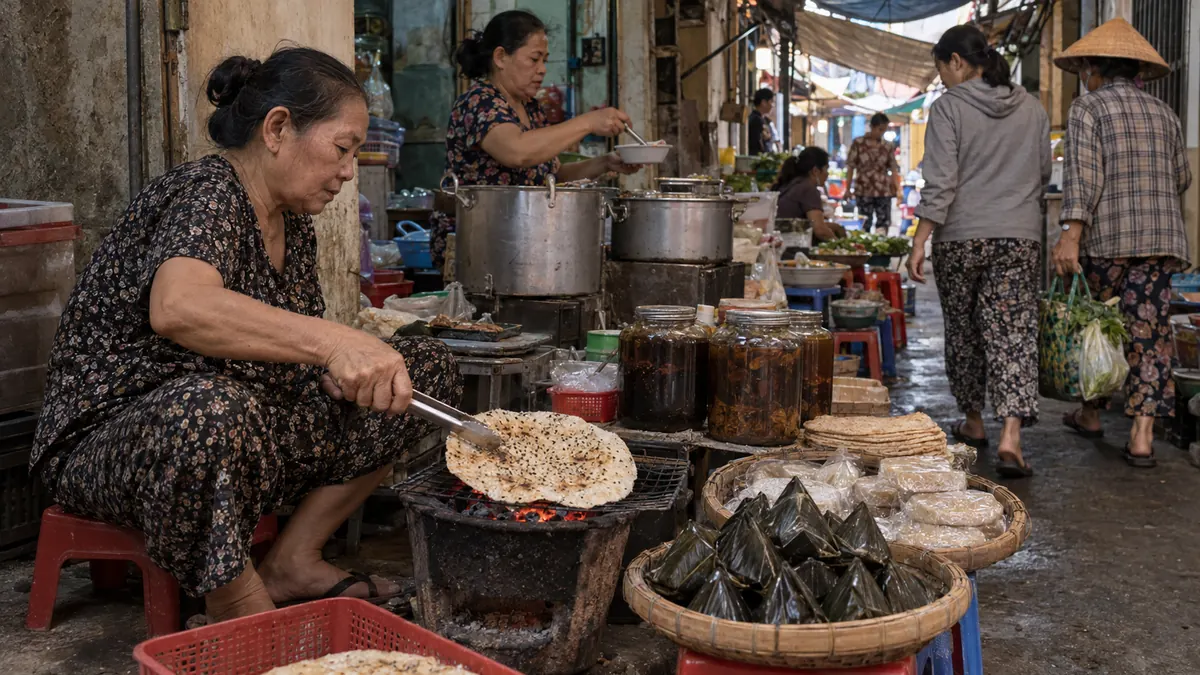
Vietnam is long and narrow from north to south, and the seasoning and ingredients of the center, south, and north are effectively different worlds. The south leans sweet, the north light, and the central region is defined by salt, chili, and rich, fermented flavors. The Bay Hien area was originally a district where people from central Vietnam gathered for the textile trade, and its market has functioned as the kitchen that supports that life. Mornings bring fresh produce; from around 2 p.m., stalls line the alleys and cooked-to-order grilled and stewed dishes take center stage. Smoke from crackers grilled golden over charcoal, the smell of fermented fish sauce, steam from simple sweets. Because it has not been turned into a tourist spot, the prices and flavors remain geared to locals.
The goods on display are all central Vietnam, too. The shelves are packed with central-only ingredients you'd rarely see in a southern market: Binh Dinh-style rice paper with coconut, Quang Nam's Dai Loc-style rice sheets for rolling, sesame-dusted rice crackers. The sweets, too, often carry regional names outright—'banh thuan,' baked to open up yellow like a flower; the black, leaf-wrapped 'banh it la gai'; and the white sugar confection 'duong phoi' (lung sugar), named for its lung-like shape. The more you've traveled central Vietnam, the more just looking at the shelves should stir memories of the place.
What You Can Buy and What You Can Eat
From sweets to fermented seasonings, the central region's goods are all here. Prices are a guide based on typical local street-stall rates, converted at about 170 dong to the yen. Much is sold by weight without a marked price, so in practice it's settled through back-and-forth with the shop.
| Dishes and items | Characteristics | Price guide (in yen) |
|---|---|---|
| mi Quang | Quang Nam's signature flat noodles—a central-Vietnamese classic tossing pork, shrimp, roasted peanuts, sesame rice crackers, and herbs in a small amount of broth | About 30,000–50,000 dong (180–290 yen) |
| banh dap with mam nem | A central-Vietnam snack: toasted rice crackers layered with moist rice sheets, eaten with a fermented anchovy dip | about 15,000–25,000 dong (90–150 yen) |
| Banh beo | A one-bite dish of steamed rice batter in small dishes, topped with dried shrimp and scallion oil | About 20,000–30,000 dong (120–180 yen) |
| suong sao | A translucent agar sweet made from seaweed. A chilled dessert served with brown-sugar syrup and candied ginger | about 10,000–15,000 dong (60–90 yen) |
| Banh to | A Quang Nam local sweet of glutinous rice flour steamed and set with sugar, ginger, and sesame | About 5,000 to 10,000 dong (30 to 60 yen) |
| Various mam (fermented fish sauce) | Jarred goods favored in Quang Ngai, such as mam cai, mam nem, and mam made from sardines or flying fish | About 30,000 to 60,000 dong (180 to 350 yen) |
Voices seeking the 'taste of home' gather in the lanes
The article was written by Thu Hà, a writer from Quang Ngai. She lives in Saigon with her family and can return to her hometown only a few times a year. She writes that "every time I come back to the city, I miss the market unbearably." That one line distills how Bà Hoa Market is not just a place to shop but a device for soothing homesickness.
According to the article, the market draws migrants from central Vietnam who come seeking mam and hometown sweets that are hard to find in the south. It means a lot that flavors once available only back home can be bought right in the middle of the city.
At the stalls, owners hunch over charcoal fires and toast rice crackers one by one. The sight of ready-made dishes being cooked all over the market is just as the article describes it—“like a country gathering place”—with an air of sellers and buyers alike hailing from the same region.
For Japanese travelers: tips on timing and location
The market runs along Tran Mai Ninh Street in the Ba Hien area of Tan Binh District. It's about 20 minutes by taxi from Ben Thanh Market in District 1—off the tourist route, but the prices are gentler for it. Aim for one of two windows. For a careful look at produce and sweets, go from early to late morning; to graze on cooked dishes at the stalls, after 2 p.m. is best. The market is busiest from dawn through midday, with bicycles and vending carts lined up at the entrance. Try a few kinds of mi Quang and banh beo and finish with xu xoa (a chilled jelly dessert), and you'll feel like you've made a loop through central Vietnam.
A few practical notes. Mam comes bottled, so it makes a good souvenir, but the smell is strong, making it better suited to checked luggage than carry-on. Stalls are basically cash-only, so bring plenty of small bills. Goods sold by weight often have no listed price, so it's reassuring to confirm the total with the vendor before ordering. Don't expect English menus for tourists, so it's quicker to jot down the dish names you want and point. The stalls' prepared dishes are most varied from early afternoon into the evening.
How it differs from Ben Thanh and Cholon
Saigon’s famous markets—tourist-thronged Ben Thanh and Binh Tay in the Cho Lon Chinatown—lean heavily toward souvenirs and wholesale. Many night markets also skew toward photogenic stalls and goods aimed at foreigners. Ba Hoa Market, by contrast, is a “regional market” singularly devoted to the food of one area, central Vietnam. A market where what you can buy under one roof is unified around the center—not the south or the north—is rare. The homogeneity of sellers and buyers both from central Vietnam keeps the seasoning true to its roots.
For anyone who wants to understand Vietnam's regional differences by taste, being able to experience central-Vietnamese food without traveling all the way to Hue or Hoi An is a value unique to this market. The shorter your stay and the less able you are to build a trip to the center, the more welcome a market that lets you grasp its outline in half a day. Conversely, if you prioritize photogenic shots or a large haul of souvenirs, the big markets downtown suit you better—use each according to your purpose.
Summary
Cho Ba Hoa is a central-Vietnamese kitchen that migrants from the war years spent half a century preserving. It barely appears in guidebooks, yet central food—from mi Quang to fermented mam to simple local sweets—is packed into a single lane. Just a short trip from District 1, and you can feel like you've traveled Hue or Quang Nam. If your Saigon stay has a half-day to spare, this quiet market is well worth grazing through for a taste of central Vietnam.
Sources
- Saigoneer, "Chợ Bà Hoa Transports Central Vietnam’s Universe of Crispy, Funky, Sugary Treats to Saigon" (July 15, 2026)
- Eat your way across Hue, the city of royal cuisine, for 1,200 yen a day—a journey of noodles and rice-flour sweets
- Six in a day gets people talking: touring Hoi An's famous banh mi shops, with prices
- Moon crab and vu nang shellfish: eating Con Dao's rare seafood cheaply at morning markets and fishing villages