"They tricked me into mistaking it for Japanese yen" — the latest 2026 edition of tourist scams surging in Hanoi
As of May 2026, Vietnam remains at the US State Department's travel advisory Level 1 (normal precautions), and violent crime is still rare.On the other hand, scams targeting tourists grow more sophisticated year by year,and "card swapping," "exchanged-bill swapping," and "card-gambling scams" have surged since the start of 2026 on Hanoi's Pham Ngu Lao Street, around Ben Thanh Market in Ho Chi Minh City, and in the entertainment districts of Nha Trang. Cases affecting Japanese travelers have also been reported, and the Japanese Embassy in Vietnam has stepped up its warnings.
The main scam methods confirmed in 2026
Combining the Canadian government's travel information, local English-language papers, and tourist police announcements, the frequent scams in 2026 can be organized into 10 types. The one with the largest losses is the "card-gambling scam," where in the budget-lodging districts of Hanoi and Ho Chi Minh City, travelers approached with "my relative is thinking of moving to Canada, so please give me advice" are invited to a home and lose cash on the order of thousands of dollars — cases that just won't stop.
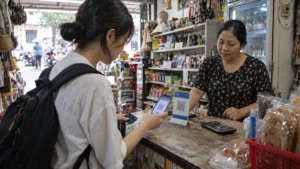
Another with many victims is the "exchanged-bill swap." Vietnam's 500,000 VND note and 20,000 VND note both have bluish designs, making them hard for unfamiliar foreigners to tell apart in an instant. The method of swapping the bill just before payment at stalls or money changers has become a staple.
List of the 10 major scams and losses
| Type of scam | Main locations | Typical loss | How to spot it |
|---|---|---|---|
| Card-gambling scam | Pham Ngu Lao in Hanoi, De Tham Street in Ho Chi Minh City | 1,000–5,000 USD (about 150,000–750,000 yen) | "Overseas Vietnamese" who approach you friendly on the street |
| Exchanged-bill swap | Stalls, street money changers, taxis | 500,000 VND (about 3,000 yen) per time | Swapping 500,000 VND for 20,000 VND |
| Taxi overcharging | Noi Bai Airport, around Hoan Kiem Lake | 3–10 times the legitimate fare | Fake Vinasun or Mai Linh white-and-green color scheme |
| Motorbike rental damage claims | Nha Trang, Hoi An, Da Nang | 200–500 USD (about 30,000–75,000 yen) | Faked accidents right after your passport is taken as collateral |
| Seafood price markup | Nha Trang, Ha Long Bay pleasure boats | 2–4 times the legitimate price | Menu prices vaguely written as "per kg" |
| Shoe-shine overcharging | Hanoi Old Quarter, around Hoan Kiem Lake | 1–2 million VND (about 6,000–12,000 yen) | Starting on their own even after saying "free" |
| Fruit / carrying-pole photo fees | Hoi An, around the Ho Chi Minh Mausoleum in Hanoi | 200,000–1 million VND (about 1,200–6,000 yen) | Saying "photo OK" and billing you afterward |
| ATM skimming | Street-installed ATMs in general | The full amount up to the card limit | Touch the card slot to check for tampering |
| SIM card expiry scam | Stalls around airports and convenience stores | 10–30 USD (1,500–4,500 yen) | A "30-day plan" stops after a few days |
| Fake-menu shops | Tourist areas in general | 3–5 times the legitimate price | Menus that don't display prices |
Voices from locals and the industry
- Hanoi tourist police spokesperson: "Tourist victimization confirmed on Pham Ngu Lao Street in the first quarter of 2026 was up 38 cases year on year. Seventy percent of card-gambling scam victims were solo travelers."
- Nguyen Thanh Hung, front-desk manager at a District 1 hotel in Ho Chi Minh City: "For guests right after check-in, I verbally tell them every time, 'Never go along with someone who approaches you on the street speaking fluent Japanese.' I get one or two consultations a day."
- A consular section official at the Japanese Embassy in Vietnam: "Exchanged-bill swap cases have been trending up since 2025. In most cases it can be prevented just by counting out the bill's denomination aloud on the spot right after receiving it."
- Le Van Hieu, who runs a motorbike rental business in Nha Trang: "There are unscrupulous operators even within the industry who take a passport as collateral and fabricate damages afterward. Those renting should be sure to check Google reviews and word of mouth."
Impact on Japanese travelers and concrete countermeasures
Japanese tourists are especially likely to be targeted because of three known tendencies: "cash-oriented," "unfamiliar with English," and "wanting to avoid disputes."The self-defense measures for the 2026 edition of Vietnam travel boil down to a three-piece set: "read the denomination aloud, ATMs inside banks, the Grab app."That's the summary.
After exchanging money, count the received bills aloud by denomination, leaving no room for a swap. Use ATMs that are inside a bank branch, never at convenience stores or on the street. For taxis, don't hail one on the fly; book and lock in the fare with the Grab app. This alone prevents 7 of the 10 types above.
When touring Hanoi's heritage cafés,scams also tend to be less likely the more you step off the tourist areas into the alleys. Areas used by local residents, rather than the crowded main streets, have clearer price displays and are safer.
Ripple effect on the industry — strengthened cooperation between tourist police and the embassy
In April 2026, the Vietnam National Administration of Tourism announced it would set up multilingual hotlines for the tourist police in major tourist cities. Japanese support is still limited, but the reporting desks in English, Chinese, and Korean will operate 24 hours. Furthermore, Hanoi city authorities have increased undercover investigators around Pham Ngu Lao Street and are advancing crackdowns on card-gambling scam groups.
On the Japanese side too, major agencies such as JTB and Nippon Travel Agency have newly included a "scam case collection" in their 2026-edition Vietnam travel guides.In popular resort areas like Da Nang and Nha Trang,the practice of hotels handing out Japanese warning cards at check-in is also spreading.
Practical information for when you fall victim
| Situation | Contact / response | Notes |
|---|---|---|
| Emergency (robbery, assault) | 113 (police) | Common nationwide across Vietnam |
| Tourist police hotline | +84-69-219-7050 | English support, 24 hours |
| Japanese Embassy in Vietnam (Hanoi) | +84-24-3846-3000 | Responds even after hours in emergencies |
| Japanese Consulate-General in Ho Chi Minh City | +84-28-3933-3510 | Covers the entire south |
| Lost credit card | The international toll-free number on the back of the card | Stop it immediately + check the usage statement at your hotel |
| Lost passport | File a loss report at the local police → reissue at the embassy | Two ID photos and a family register copy needed |
Summary — three actions to enjoy your 2026 Vietnam trip safely
For your 2026 Vietnam trip,just thoroughly following the three points "split your cash across wallets," "ATMs only inside banks," and "don't go along with people who approach you"will let you avoid the majority of reported scam victimizations. Scam methods evolve, but the basic moves don't change.
Before traveling, it's also effective to check the latest warning pages of Vietnam's Ministry of Foreign Affairs and the Japanese Embassy in Vietnam, and to share your accommodation and means of contact with family.Vietnam's spiritual tourismBy combining calm areas like this, you can further lower the risk of getting caught up in trouble. Keep your safety measures airtight and enjoy Vietnam's unique food, culture, and nature to your heart's content.